
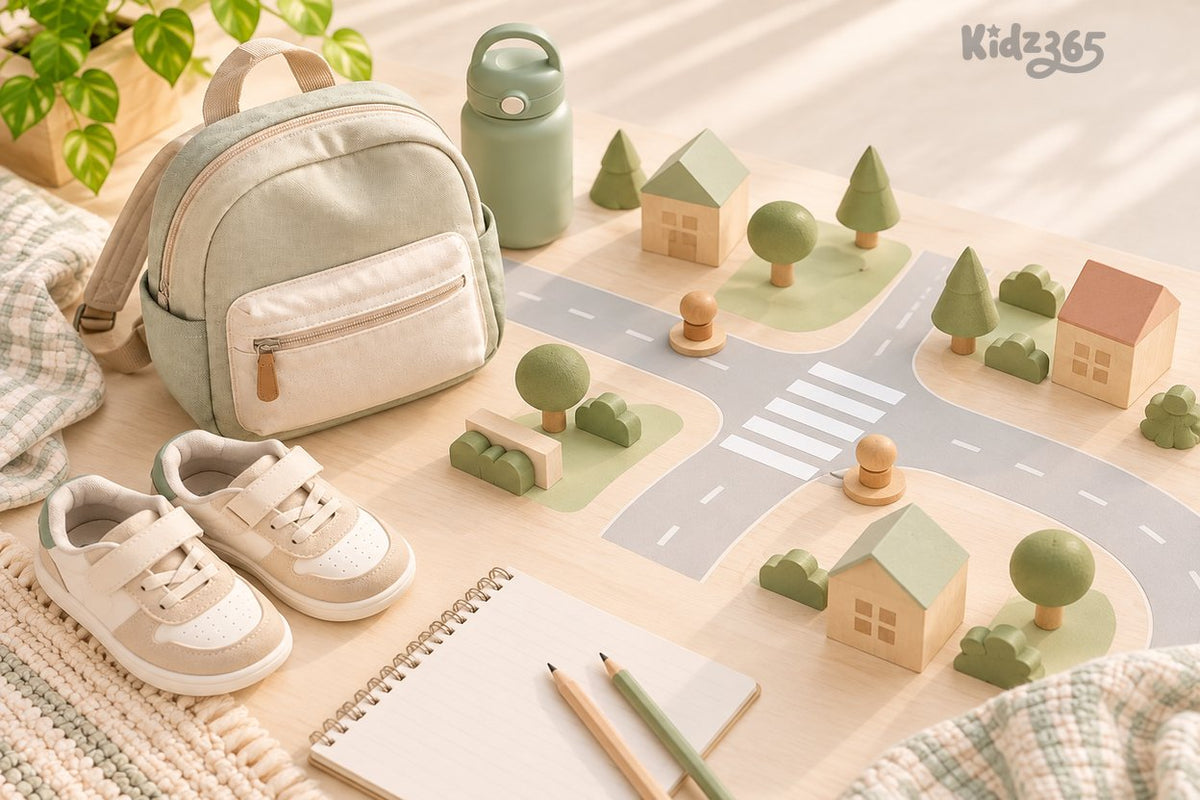
A school walk can look simple until you notice the driveway with poor visibility, the busy turn at the corner, or the crossing where cars sometimes roll past the line. Instead of giving kids a long list of rules, practice one real part of the route together.
Try this five-minute Kidz365 routine: Route · Stop · Scan · Cross. The goal is not to make a child memorize a script. It is to help them slow down, notice what is happening around them, and make the same safer choices repeatedly.
The 5-minute route rehearsal
1. Route: choose the safer crossing, not the shortest shortcut
Walk the route at the time your child normally travels if you can. Prefer sidewalks or walking paths, marked crossings, lower-speed streets, crossing guards, and fewer complicated intersections. The American Academy of Pediatrics recommends practicing the actual route before a child begins walking independently; NHTSA also suggests assessing school routes as a family.

2. Stop: make the curb a full pause
At every street edge, stop before stepping into the roadway. Treat driveways and parking-lot exits like mini crossings too. Cars may be turning or backing up even when the main road looks quiet.
3. Scan: look left, right, left—and keep looking
Phones stay away and earbuds come out. Look for moving cars, bikes and scooters, then check again while crossing. If a driver is involved, make eye contact when possible and wait for the vehicle to come to a complete stop rather than assuming you have been seen.
4. Cross: use the crossing, then walk straight across
Use a crosswalk or corner whenever possible and follow pedestrian signals and crossing guards. Walk briskly in a straight line instead of running, and keep scanning until you are safely on the other side.
Practice one tricky spot—not the whole commute
You do not need a 30-minute safety lesson. Pick the crossing that requires the most judgment and repeat it two or three times. On the last try, let your child lead and explain what they are checking before they move.
A useful prompt is: “What do you need to know before your feet leave the curb?” Their answer matters more than perfect wording.

When is a child ready to cross or walk alone?
There is no single birthday that makes every route safe. The AAP says most children are not ready to cross streets alone until at least about age 10, and NHTSA advises that children under 10 should not cross streets alone. Route complexity, traffic speed, visibility, impulse control and the child’s ability to follow the routine consistently all matter.
For a first independent walk, choose a familiar route with lighter traffic, lower speeds and as few crossings as practical. A walking buddy or supervised “walking school bus” can be a useful step between fully accompanied and fully independent travel.
Three small upgrades that help
- Make the child easier to see. Bright clothing or reflective details can help, especially in low light.
- Keep distractions out of the crossing. Put phones away and remove headphones before approaching traffic.
- Keep the load comfortable. A bag that pulls a child backward or changes how they walk is worth adjusting. See our 5-minute backpack fit and weight check, and if shoes have suddenly become snug, try our school-shoe fit check.
Quick answer: what should a child do before crossing?
Stop at the edge, look left-right-left, listen, confirm vehicles have stopped, use the crosswalk or corner, and keep watching while walking across. Follow local traffic laws, pedestrian signals, school instructions and crossing guards even when they differ from a general rule of thumb.
This article provides general pedestrian-safety information, not a substitute for local traffic rules or individualized safety planning. Young children and children who need additional mobility, attention or developmental support may need closer adult supervision for longer.
Sources & further reading
- American Academy of Pediatrics — Pedestrian Safety Tips for Families
- NHTSA — Pedestrian Safety
- NHTSA — Walkability Checklist Guide
Image credits
Crosswalk photo: Kamaji Ogino, Pexels source page, Pexels License (free commercial and non-commercial use; attribution not required).
Child-at-curb photo: Sara Er, Pexels source page, Pexels License (free commercial and non-commercial use; attribution not required).


