
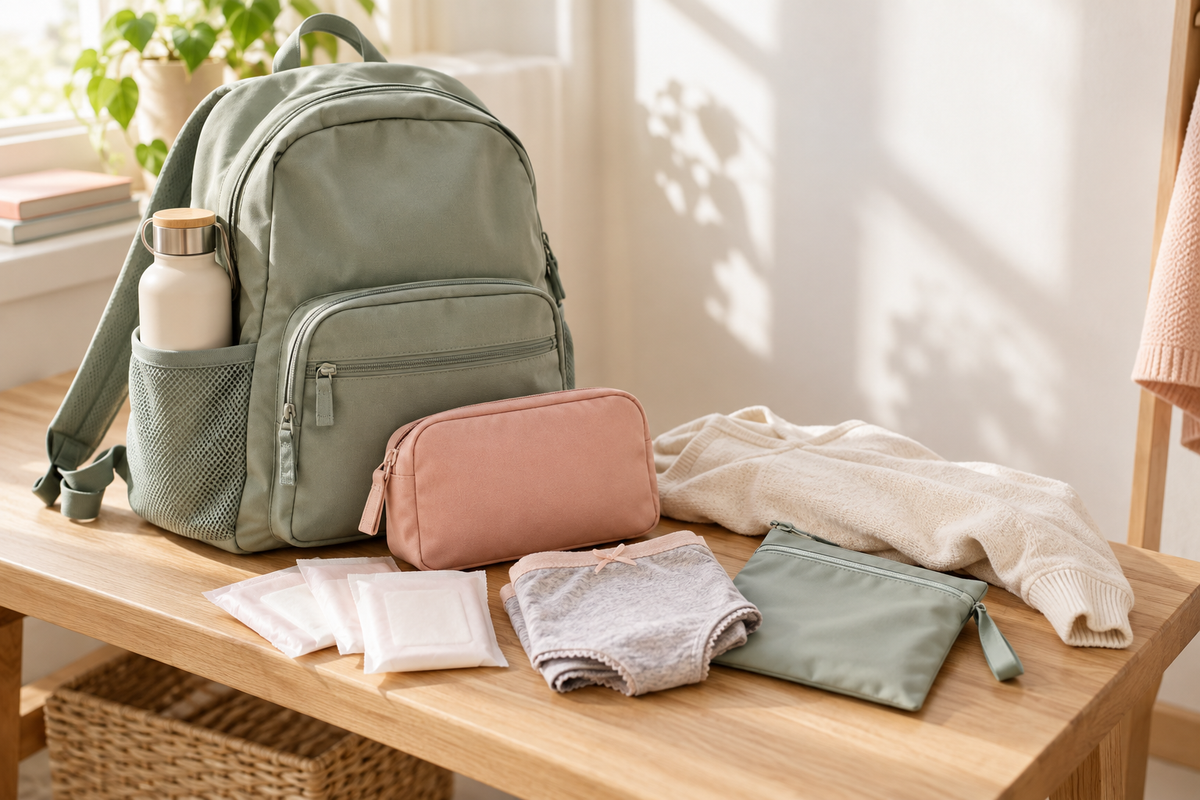
A first period does not always wait for a convenient Saturday at home. It can begin during math class, at practice, on the bus, or halfway through the school day. A little preparation can turn that surprise from a crisis into a manageable moment.
The goal is not to predict the exact day. It is to give your child a small, discreet plan they already understand. The American Academy of Pediatrics notes that most first periods happen within about 2–3 years after breast development begins, and specifically recommends keeping menstrual supplies in a backpack or locker and knowing what support is available at school.

The 5-part just-in-case plan
1. Pack two or three simple menstrual products
For a first school kit, pads are often the easiest place to start because they do not require insertion. Pack two or three individually wrapped pads in a small opaque pouch. If your child already prefers another product, follow its instructions and make sure they know how and when to change it.
2. Add clean underwear and a discreet wet bag
One spare pair of underwear can solve the most common practical worry: a leak before your child notices. Add a small opaque zip or washable wet bag for stained clothing. A lightweight pair of shorts or leggings can also help if the school allows room in the backpack.

3. Choose one place and one adult at school
Before the first period arrives, help your child identify where they can go if they need a pad, a bathroom break, clean clothes, or a quiet minute. Depending on the school, that might be the nurse, front office, counselor, teacher, or another trusted staff member. Ask where menstrual products are available rather than assuming every school stocks them in the same place.
4. Rehearse one sentence
Kids sometimes know what to do but freeze when they have to say it out loud. Practice a simple line such as, “I think my period started. Can I go to the restroom or nurse?” No long explanation is needed. The point is to make asking for help feel ordinary.
5. Make a home contact plan
Decide who your child should text or call, what happens if clothes are stained, and when they would actually need to be picked up. Many first periods are light and can be managed at school; knowing that ahead of time can prevent a small surprise from feeling like an emergency.
Signs a first period may be getting closer
Timing varies from child to child. Breast development usually starts before the first period, and vaginal discharge may become noticeable months beforehand. The first flow may be bright red, reddish-brown, or just light spotting. Early cycles can also be irregular while the body settles into a pattern.
Instead of repeatedly asking, “Do you think it is coming soon?”, keep the kit stocked and let your child know they can ask questions without embarrassment.
What not to overpack
You do not need a miniature pharmacy. Skip fragranced “feminine hygiene” products, complicated supplies your child has never used, and medication unless you already have a safe plan that follows your clinician’s advice and the school’s medication rules. A familiar pad, clean underwear, a discreet bag, and a help plan cover most first-day needs.
When to check in with a clinician
Puberty has a wide normal range, but a pediatrician or other qualified clinician can help if menstruation begins unusually early, has not started by around age 15, or if your child has very heavy bleeding, severe pain, fainting or dizziness, or symptoms that repeatedly keep them from school or normal activities. Do not use an article to diagnose a menstrual problem.
Quick questions parents ask
Is brown blood normal for a first period? It can be. A first period may look red, reddish-brown, or like light spotting.
Will the next period come exactly a month later? Not necessarily. Irregular cycles are common in the first few years.
Should the kit stay in the backpack all year? Yes, if your child is comfortable with that. Check it occasionally so products are clean, wrappers are intact, and spare clothing still fits.
A calmer way to frame it
The most useful message is simple: menstruation is a normal body process, it is okay to ask for help, and there is a plan if it starts away from home. That sense of readiness matters more than a perfectly packed pouch.
This article provides general educational information and is not medical advice. For concerns about puberty timing, bleeding, pain, dizziness, or your child’s individual health, contact a pediatrician or other qualified health professional.
Sources & further reading
American Academy of Pediatrics / HealthyChildren.org: Physical Development in Girls: What to Expect During Puberty
Nemours KidsHealth: When Will I Get My Period?
Women and Gender Equality Canada: Menstrual Equity Fund
Secretaría de Salud, México: Estrategia Nacional por una Menstruación Digna
Image credits
Parent-and-teen conversation: Pavel Danilyuk via Pexels — source page. Pexels License; free for commercial website/blog use, attribution not required.
Menstrual pad still life: Kaboompics via Pexels — source page. Pexels License; free for commercial website/blog use, attribution not required.


